
How a Home Health AI CRM Turns Patient Trust Into Community-Driven Growth
Referral growth is not driven only by hospitals, physicians, SNFs, and discharge planners. Patients, families, and caregivers also influence which agency gets chosen, remembered, recommended, or requested.
That does not mean institutional referrals matter less. They still matter a lot. But families are not passive in care decisions. They read reviews, ask questions, compare agencies, talk to friends, and remember names they have seen in the community.
Many agencies already create strong patient experiences every day. A caregiver feels supported. A patient regains confidence at home. A family avoids confusion after discharge. But those trust signals often stay hidden because reviews, testimonials, life stories, case studies, and community education are not captured or shared consistently.
A Home Health CRM can help turn those moments into a structured community and patient marketing engine that builds community trust, local visibility, and patient-driven demand.
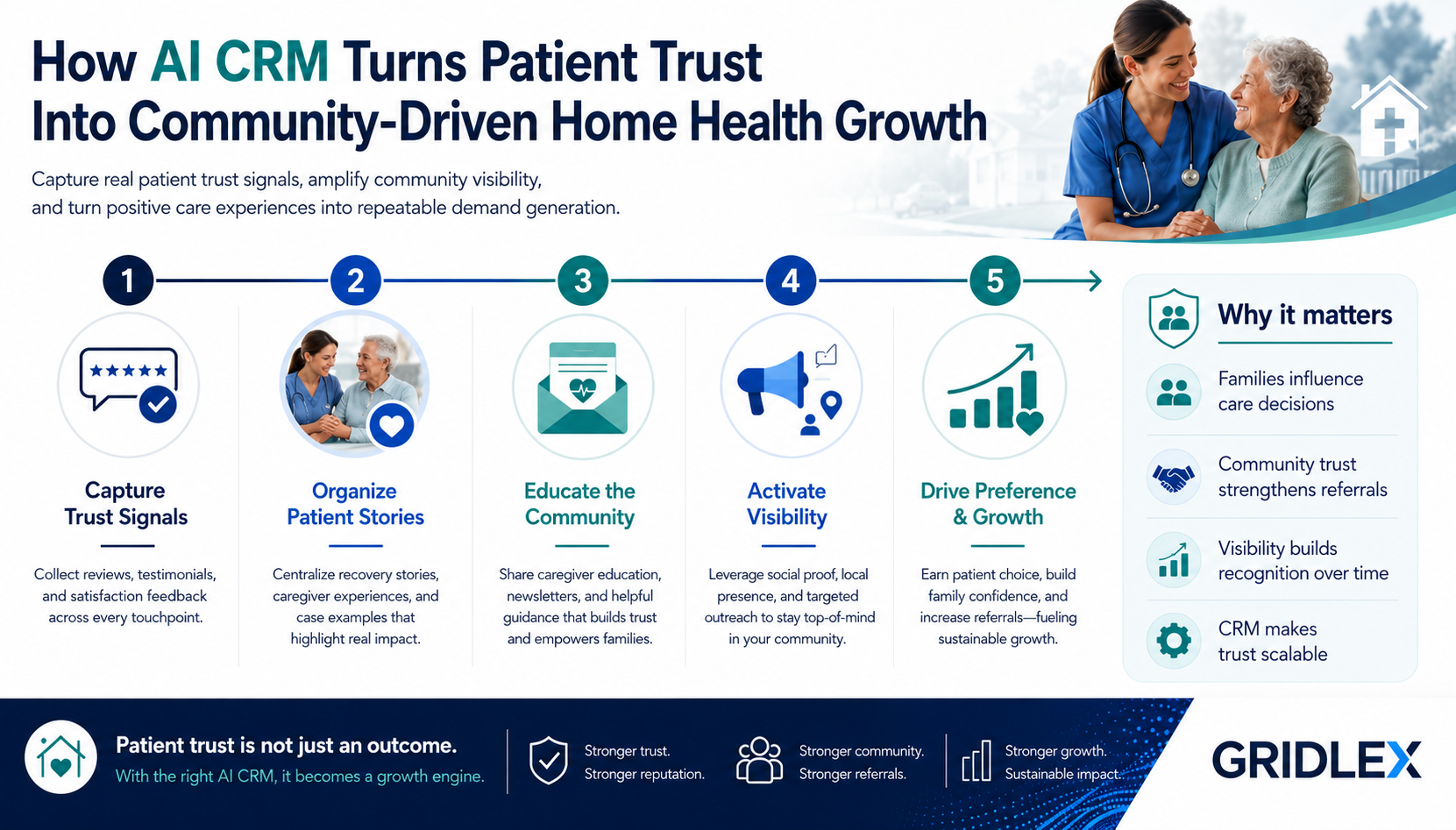
Why Patient and Family Preference Matters
Patients and families may not always control the referral, but they can influence the conversation. A family member may ask a physician about a specific agency. A patient may tell a discharge planner they prefer a provider they recognize. A caregiver may recommend an agency to another family in the community.
This is where local visibility matters. If an agency is only known to referral sources, it may be missing a second layer of growth: patient and family preference.
Community trust also supports institutional referral confidence. Physicians and discharge planners are more comfortable recommending agencies that patients recognize, families trust, and communities speak positively about. A strong reputation makes the agency feel less like an unknown provider and more like a familiar care partner.
Turning Patient Experience Into Trust Assets
Home health is personal. Agencies are invited into the patient’s home during vulnerable moments, often after hospitalization, surgery, illness, or functional decline. That creates meaningful stories, but those stories need structure.
A CRM can help agencies organize patient and community marketing around real experience signals, such as:
- Review collection and reputation follow-up
- Testimonial collection workflows
- Patient experience and satisfaction signals
- Recovery stories, life stories, and case studies
- Caregiver education content
- Community newsletters
- Social proof campaigns
The goal is not to over-market patient stories or make care feel transactional. The goal is to capture authentic trust signals with permission, sensitivity, and consistency. When done well, patient experience becomes a source of education, reassurance, and local credibility.
Building Community Visibility Consistently
Community marketing works best when it is not random. Posting once after a positive review or sending an occasional newsletter may help, but it does not create sustained recognition.
A CRM-driven approach makes community visibility more repeatable. Agencies can plan regular caregiver education, patient recovery tips, local health awareness posts, review campaigns, and newsletter features. They can also segment communication by audience, so families receive education that feels useful, while referral partners see proof of patient trust and community presence.
This matters because trust builds over time. A family may not need home health today, but they may remember an agency that consistently shares helpful guidance. A physician may not refer this week, but they may notice that the agency has strong reviews, clear patient education, and visible community engagement.
Example: From Patient Feedback to Community Campaign
Consider a caregiver who shares positive feedback after a parent recovers safely at home. Without a system, that feedback may stay in an email, survey comment, or staff note.
With the right CRM workflow, the agency can request a review, ask for permission to use a short testimonial, turn the experience into a caregiver education message, feature a de-identified recovery lesson in a newsletter, and create a social post about safe recovery at home.
One positive experience becomes more than a nice comment. It becomes a trust-building campaign that helps other families understand what good home health support can look like.
How Gridlex Helps
Gridlex helps agencies organize community and patient marketing inside the Home Health CRM. It can support review collection, testimonial workflows, patient stories, life stories, caregiver education, community newsletters, social proof campaigns, and social media content distribution.
By connecting patient experience signals with marketing automation, Gridlex helps agencies turn community trust into a repeatable demand-generation engine. Teams can strengthen local visibility, keep patient and family audiences engaged, and make positive care experiences easier to capture and share.
For agencies trying to grow, this adds an important layer to referral strategy. Instead of depending only on institutional relationships, agencies can build recognition among the people who experience care most directly.