
How Biopharma CRM Native Marketing Automation Closes the Gap Between Marketing Signals and Sales Execution
Posted In | CRMBiopharma marketing teams have become highly sophisticated at generating HCP engagement. Email campaigns, webinar invitations, patient support updates, access announcements, clinical content, and branded portal programs can all show which HCPs are engaging and what topics are gaining traction.
But the real commercial value does not come from the campaign alone. It comes from what happens after the engagement.
In many organizations, marketing automation sits outside the CRM. Marketing owns the campaign platform. Sales owns the CRM. Engagement data lives in one system, while rep call planning, HCP history, access context, and follow-up tasks live in another. The result is a familiar gap: marketing sees signals, but sales does not always receive them in time, in context, or in a form that tells the rep what to do next.
A physician may click on an access update, register for a webinar, or spend time reviewing patient support resources. But if that signal stays in a separate marketing automation tool, the rep may still walk into the next call without knowing it happened.
Why Separate Marketing Automation Creates Execution Gaps
Standalone marketing automation tools can send campaigns and report engagement, but they often struggle to support field execution because they are not the system where sales activity happens. The CRM is where reps manage accounts, calls, samples, notes, tasks, access conversations, and follow-up. When campaign execution is separated from that workflow, signals become reports instead of actions.
The problem starts with segmentation. Marketing teams often build audiences using exported lists or synced data that may not reflect the latest HCP status, territory ownership, consent rules, affiliations, payer relevance, or field activity. Even small delays can matter, especially during launches, access changes, or competitive response campaigns.
The next issue is timing. Engagement data may be reviewed in dashboards or sent to the field after the moment has passed. A click that should have triggered a same-week follow-up becomes a line in a report. Reps then receive broad engagement lists rather than clear guidance on which HCPs to prioritize, what content they engaged with, and what message would be most relevant.
Attribution also suffers. Marketing can report opens and clicks. Sales can report calls and activities. But leadership struggles to connect the two. Did the campaign lead to rep follow-up? Did follow-up happen quickly enough? Did the HCP continue engaging after the call? Did the access update influence territory activity? When systems are disconnected, these questions require manual analysis, exports, and assumptions.
What Native CRM Marketing Automation Changes
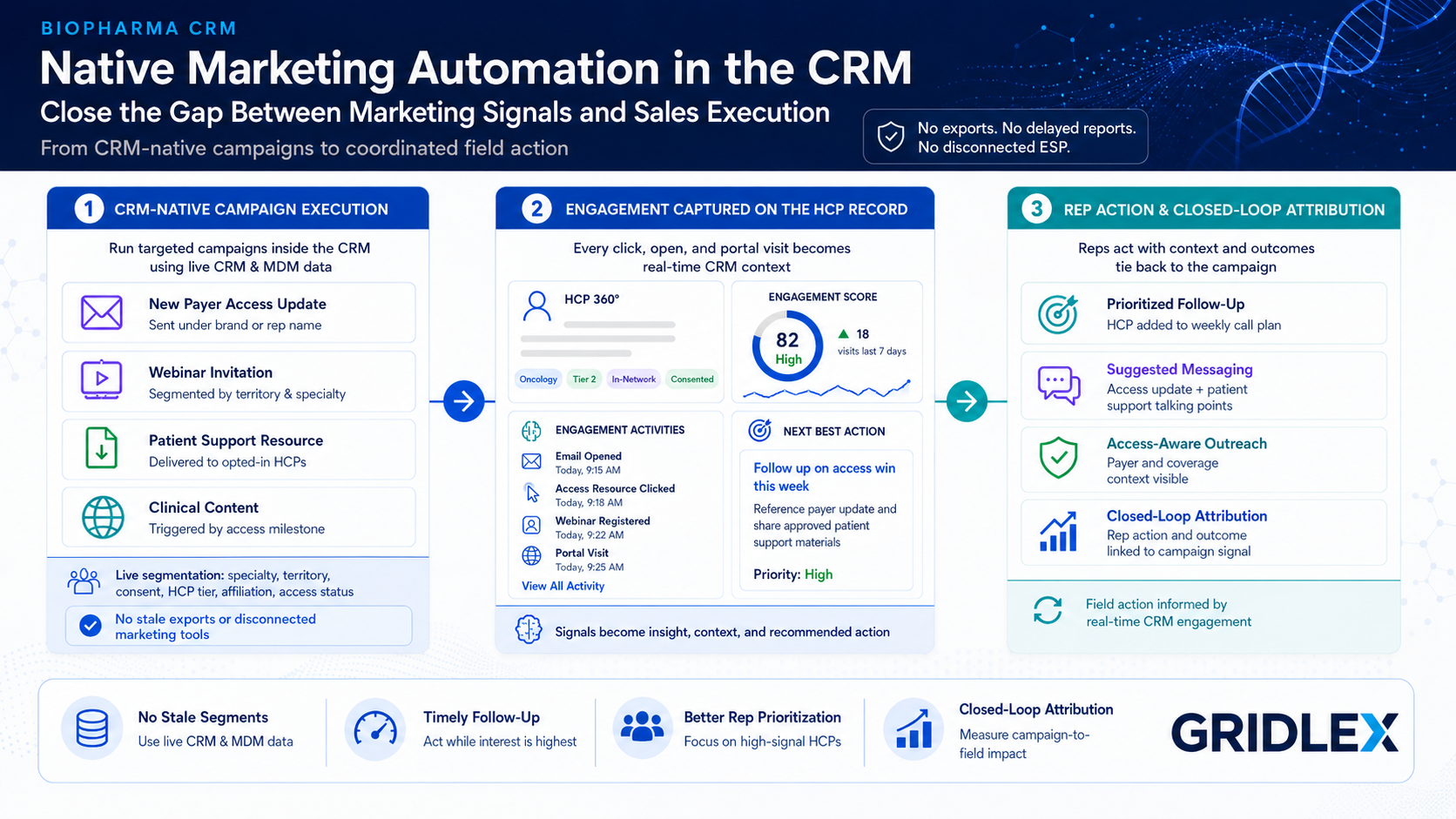
When marketing automation is native to the CRM, campaigns are no longer disconnected from sales execution. Marketing can build, launch, and measure campaigns using the same HCP and HCO data that reps use every day. Engagement becomes part of the customer record, not a separate marketing artifact.
This changes the workflow in practical ways:
- Campaign segments can use live CRM and MDM data, including specialty, territory, consent, affiliation, HCP tier, access status, and prior engagement.
- Campaigns can be sent as brand-level outreach or rep-named communications, while keeping governance and template controls intact.
- Opens, clicks, portal visits, and content engagement can appear directly on the HCP record.
- Strong engagement can trigger rep alerts, follow-up tasks, suggested messaging, or next-best actions.
- Marketing and sales can measure whether a campaign signal became a field action.
This is where the value shifts. Marketing automation stops being only a send-and-measure tool. It becomes part of the commercial operating system.
Example: Turning an Access Update Into Sales Execution
Consider a specialty biopharma company communicating a new payer access win. In a traditional setup, marketing builds the campaign in a separate tool. The audience is exported from CRM, filtered, uploaded, and launched. The campaign performs well, with strong clicks on access resources.
But the field team may not know which HCPs clicked, which territories were affected, or which accounts should be prioritized. By the time a report reaches sales, the access message has already lost urgency.
In a CRM-native model, the campaign is built directly inside the CRM using live HCP and HCO data. Marketing can segment by territory, specialty, payer relevance, consent, and affiliation. The campaign can go out under the brand or under the assigned rep’s name. When an HCP clicks the access resource, that activity is captured on the HCP record immediately.
The CRM can then recommend a follow-up: prioritize this HCP this week, reference the access update, share approved patient support materials, and log the outcome after the conversation. Marketing sees engagement. Sales sees context. Commercial operations see whether the signal became execution.
How Gridlex Does It
Gridlex brings marketing automation directly into its Biopharma AI Unified CRM x MDM platform, so organizations can reduce or eliminate the need for a separate marketing automation system for HCP campaign execution. Campaigns, segmentation, engagement tracking, CRM activity, HCP master data, access context, AI agents, and follow-up workflows operate in one connected platform.
Marketing teams can create and launch compliant campaigns from inside Gridlex. Segments can be built using live CRM and MDM data rather than stale exports. Campaign engagement is tied directly to HCP and HCO records. Reps can see who engaged, what they engaged with, and what follow-up is recommended. AI agents can help convert strong signals into prioritized tasks, suggested outreach, and closed-loop insights.
For biopharma organizations, this is not just tool consolidation. It is workflow consolidation. The goal is to remove the gap between the team creating demand signals and the team responsible for acting on them.
When marketing automation is native to the CRM, the click does not end in a dashboard. It becomes context for the rep, a trigger for follow-up, and a measurable part of sales execution.